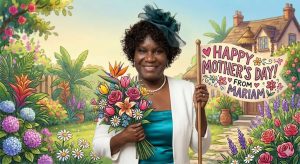
MOTHERS’ DAY – SUNDAY 15/03

The Silent Architect
​She is the quiet hum of the house before the sun,
The steady hand that mends what life has undone.
A keeper of secrets, of scrapes, and of dreams,
She sews up the world at its fraying seams.
​She measures her years not in minutes or hours,
But in birthdays and seasons and garden-grown flowers.
In the weight of a child asleep on her chest,
And the courage it takes when they fly from the nest.
​There is a strength in her softest “I love you,”
A light that remains when the sky isn’t blue.
For a mother is more than a title or name—
She is the hearth-fire, the soul, and the flame.

The Iron and the Velvet
​It is a love that breathes in two distinct ways:
The soft, steady pulse through the quietest days,
And the fierce, rhythmic beat of a heart in a fray,
That refuses to bend or to look the other way.
​Resilience is the soil where her kindness is grown,
A harvest of patience that she’s quietly sown.
When the winds rattle windows and the shadows grow long,
She is the anchor, the shield, and the song.
​With determination etched in the lines of her face,
She moves through the chaos with a tireless grace.
No mountain too high and no distance too far,
She follows her compass—her children, her star.
​Her strength isn’t found in a shout or a fist,
But in staying the course through the rain and the mist.
A builder of futures, a weaver of light,
She is the courage that conquers the night.
​Why these themes matter:
​Love: It’s the foundation, but adding resilience acknowledges that being a mother isn’t always easy—it’s earned.
​Strength & Determination: These words move the needle from “softness” to “capability,” celebrating her as a leader and a force of nature.
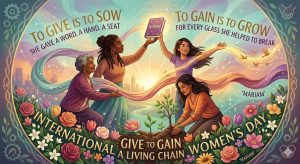
 

INTERNATIONAL WOMENS’ DAY

The Unseen Shield

​Beyond the borders drawn in sand and ink,

Where silence meets the thunder of the gale,

Stand women at the very jagged brink,

With spirits forged where earthly comforts fail.

They carry homes in bundles on their backs,

And lullabies to drown the sound of flight,

Treading through the dust of weary tracks,

To find a flicker in the hollow night.

​Justice is not a hand-out or a plea,

But the unbreaking vow to see them whole.

It is the right to breathe, to act, to be,

To mend the fractured rhythm of the soul.

​Give justice by the opening of the gate,

​By honouring the stories they have kept,

​By tearing down the scaffolding of hate,

​And drying tears that history has wept.

​When we provide the floor, the roof, the bread,

We weave a safety net that spans the earth.

For in the shelter where a child is fed,

A thousand dreams are granted second birth.

​Gain protects a harvest we all share,

​The strength of nations found in open arms,

​A world redeemed by collective care,

​Secured against the reach of future harms.

​For every woman seeking distant shores,

Whose courage is the compass and the light,

We open up the long-locked, heavy doors,

To turn the tide and set the balance right.

In giving justice, we ourselves are freed;

In gaining protection, we sow the vital seed.

EARNED SETTLEMENT PROPOSAL DEBATE IN PARLIAMENT

The Moving Goalposts: Why the UK’s “Earned Settlement” Model is a Betrayal

On February 2, 2026, I sat in a Westminster cafeteria watching from my phone a live stream of MPs debating the government’s proposed “Earned Settlement” model. My colleagues and I had travelled from Manchester to witness this, but despite petitions garnering 100,000 signatures, only 16 public seats were available. While the physical space was limited, the dissent inside was loud. Around 40 MPs—many from the government’s own benches—criticized the proposal.
​MP Tony Vaughan captured our collective fear: “Moving the goalposts” after the game has started damages the UK’s reputation and is fundamentally unjust. For refugees who built their lives on a “5-year promise” of Indefinite Leave to Remain (ILR), the path to safety will be replaced by a never-ending assessment of their worth.

My 17-Year Journey: A Lifetime on Hold

​I spent 17 years trapped in the asylum system—prohibited from working or further studying. I spent those years volunteering and learning English, proving my commitment while my future remained a question mark.
​In 2024, I finally received my status. The relief was overwhelming; I could finally seek education and prepare for employment. But the “Earned Settlement” model threatens that hard-won stability. It will demand that I continue to “score points” and “prove my character” indefinitely.

This isn’t just about bureaucracy; it’s about human lives. It’s about the constant anxiety, the mental health toll, and the feeling that you are forever on probation, never truly free to belong.
​ ​The new model proposes a system where ILR is not a guarantee but an ongoing process, requiring continuous assessment and “point-scoring.” Imagine living with:
​Every year, every month, knowing your status could be revoked if you don’t meet an ever-changing set of criteria. The ability to plan for education, career, or even starting a family becomes impossible.
​The cost of repeated applications and legal fees will be astronomical, pushing vulnerable individuals further into poverty.
​ Why would someone fully invest in a community if they feel their presence is conditional and temporary? This model undermines the very goal of integration.
​For individuals who have fled unimaginable trauma, the asylum process itself is gruelling. Adding indefinite uncertainty to this burden is a recipe for a mental health crisis.

​A Call for Fairness

​As a member of the lived experience advocacy group, we speak out, I know our voices are crucial. We raise awareness and campaign against policies that are hostile to people seeking safety. I have written to my MP, explaining how this proposal will affect individuals like me—those who have already been granted protection and are trying to rebuild their lives.
This isn’t just about immigration policy; it’s about humanity, fairness, and the kind of society we want to build. We simply want the freedom to exist in a humane, fair, and inclusive UK, where promises are kept and people are allowed to thrive, not just survive.
​ Our collective voices, like those of the 40 MPs who stood in Westminster Hall, are essential. We must continue to push back against policies that punish the vulnerable and undermine the very principles of compassion and justice.